



Table of Contents
Affiliate link notice: As an affiliate of BetterHelp and other third-party vendors, we may receive compensation if you make a purchase using the links provided on this page. For more information, visit our disclosure page.
Last Updated on September 12, 2026 by Randy Withers
Choosing a treatment center can be difficult, especially if you have never had to evaluate one before. Most facilities make similar promises about safe care, qualified staff, and effective treatment. Those claims alone don’t tell you much about what happens once you become a patient.
Accreditation can help. You may see terms such as “CARF accredited” or “Joint Commission accredited” on a treatment center’s website. These organizations review treatment programs against established standards. Depending on the accreditor and type of program, the review may cover staff qualifications, patient safety, clinical records, and other parts of patient care.
This matters because much of what makes a treatment center safe happens out of public view. Patients cannot inspect staff files, internal records, or safety procedures before they choose a program. Accreditation gives consumers an independent source of information about how a facility operates.
Accreditation does not guarantee good care or a successful outcome. It does give you another piece of information to consider when you compare treatment centers.
What Does “CARF Accredited” Mean for a Treatment Center?
CARF and The Joint Commission are independent organizations that accredit healthcare and behavioral health programs. Each uses its own standards and review process.
Accreditation is separate from state licensure. State agencies set licensing requirements based on the type of program and services provided. An accreditor reviews a program against its own standards.
For patients and families, the value is practical. Depending on the program and accreditor, a review may look at:
- Staff qualifications and credentials
- Safety and emergency procedures
- Clinical records and treatment plans
- How the program responds to safety and quality problems
These details affect patient care. They can influence who treats you, what happens in an emergency, and how the program responds when something goes wrong. A CARF accredited facility has undergone outside review against CARF standards instead of asking consumers to rely on the facility’s claims alone.
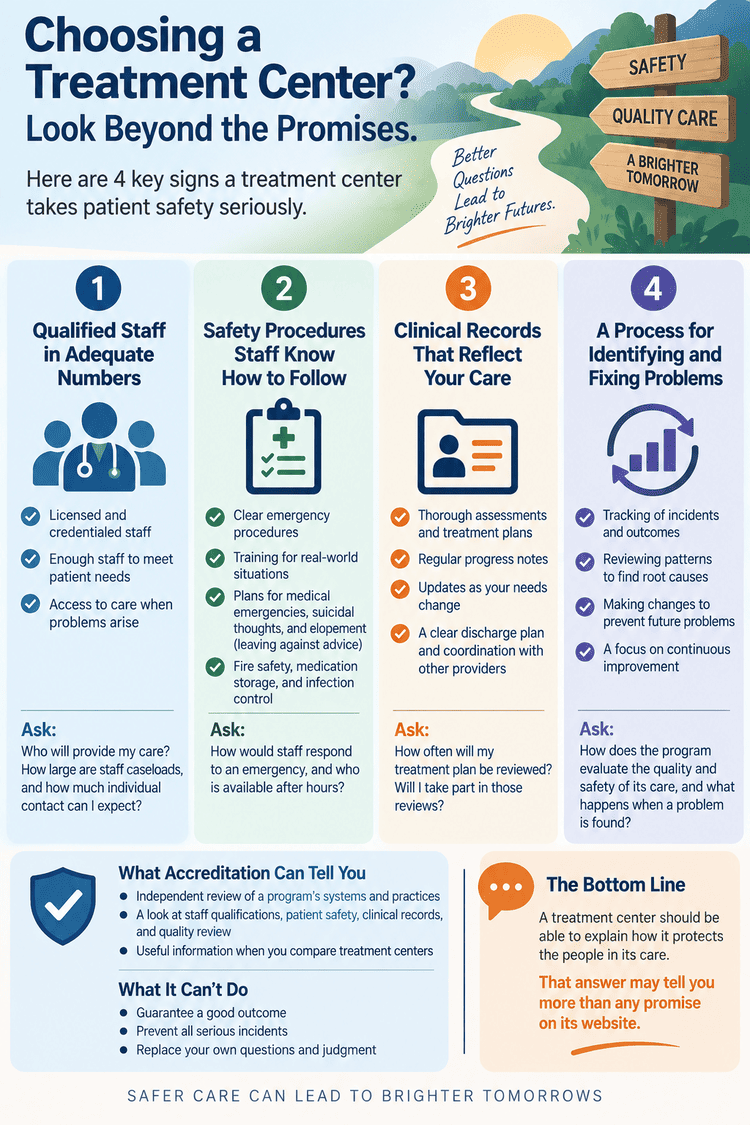
Accreditation is only one factor to consider. The following four signs a program is actually taking safety seriously can help you ask better questions before you choose a treatment center.
1. Qualified Staff in Adequate Numbers
One of the first things accreditors examine is whether a facility has enough qualified staff to care for its patients safely. This includes licensed clinicians and medical staff, as well as support staff who may spend the most time with patients day to day.
Staffing levels matter because they can affect caseloads, access to care, and how quickly someone gets help when a problem arises. A program should also verify that staff have the licenses, certifications, and training required for their roles.
When you compare treatment centers, ask:
- Who will provide most of my care, and what are their credentials?
- How large are staff caseloads, and how much individual contact can I expect?
- What clinical or medical staff are available after regular business hours?
Clear answers can tell you far more than a staff page filled with names and credentials. You want to know who will actually care for you and whether enough qualified people are available when you need them.
2. Safety Procedures Staff Know How to Follow
A treatment center should have clear procedures for emergencies. Staff should also know what to do when one occurs.
Accreditation reviews may examine how a program responds to suicidal thoughts, medical emergencies, patients who leave against advice, and other safety concerns. Reviewers may also look at medication storage, fire safety, emergency exits, and infection control practices.
The details will vary based on the type of treatment a facility provides. A residential program, for example, has different safety needs than an outpatient clinic.
Before you choose a program, ask how staff would respond to an emergency that could realistically occur there. Find out who is available after hours and what happens if a patient needs care the facility cannot provide.
Written policies matter. Staff also need to know how to use them when something goes wrong.
3. Clinical Records That Reflect Your Care
Clinical records can sound like paperwork, but they serve an important purpose. They help the treatment team stay coordinated and track a patient’s care over time.
Accreditation standards may address assessments, treatment plans, progress notes, and discharge plans. These records should reflect the care a patient receives rather than exist simply to satisfy an audit or insurance requirement.
As your needs change, your treatment plan should reflect those changes. Accurate records become especially important if you move to another level of care or transfer to a different provider.
You won’t have access to other patients’ records, but you can ask questions about the process:
- How often will my treatment plan be reviewed?
- Will I take part in those reviews?
- How does the team track my progress and adjust my care?
The answers can help you determine whether the treatment plan serves as a real guide for your care or simply another form in your chart.
4. A Process for Identifying and Fixing Problems
Problems can occur even at well-run treatment centers. What matters is whether the program identifies them, learns from them, and makes changes when needed.
One of the less visible parts of accreditation involves quality review. Programs may track outcomes and incidents over time and use that information to improve their practices. If a facility finds a pattern of medication errors, for example, it should examine the cause and take steps to prevent the problem from recurring.
Ask how the program evaluates the quality and safety of its care. A facility cannot share confidential details about individual patients or incidents, but it should be able to explain how it reviews problems and responds to them.
A strong safety system does more than react to individual complaints. It helps a treatment center spot patterns and correct problems before they become routine.
What Accreditation Can (and Cannot) Tell You
Accreditation gives you useful information about a treatment center, but it does not Accreditation should be one part of your decision. It cannot guarantee a good outcome, and an unaccredited program isn’t automatically unsafe. It does provide evidence that an outside organization has reviewed parts of the facility’s practices against established standards.
Ask which accreditation the program holds and when its most recent review took place. Then consider what you have learned about the people who will treat you, the program’s safety procedures, your treatment plan, and how the facility responds when problems occur.
Final Thoughts
People often choose treatment centers during stressful circumstances, sometimes with little time to compare their options. A polished website or reassuring phone call can make a program sound impressive. The harder questions tell you more.
Find out who will provide your care, how the program handles emergencies, and what happens when care needs or safety concerns change. Accreditation can provide useful outside scrutiny, but your own questions still matter.
A treatment center should be able to explain how it protects the people in its care. That answer may tell you more than any promise on its website.
Frequently Asked Questions
Is CARF or Joint Commission Accreditation Required by Law?
Accreditation is generally separate from state licensure. Legal requirements vary by state, type of facility, and services offered. Programs may also pursue accreditation as an additional form of external review.
Does Accreditation Mean a Program Has Never Had a Serious Incident?
No. Serious incidents can occur at any treatment center. Accreditation examines whether a program has systems to identify, report, respond to, and learn from problems when they occur.
Ask a facility how it handles serious incidents and what steps it takes after a safety problem. A clear, specific answer can tell you a great deal about its approach to patient safety.
How Can I Verify a Treatment Center’s Accreditation?
CARF and The Joint Commission maintain public directories of accredited organizations. You can search these directories yourself rather than rely solely on a facility’s website or marketing materials.
If a treatment center says it is CARF accredited or Joint Commission accredited, verify its current status directly with the accrediting organization.






Thanks for this! Very good advice. We put our daughter into a facility and I wish we had known what you listed here. It was a nightmare. Thanks for helping parents out.