Table of Contents
Affiliate link notice: As an affiliate of BetterHelp and other third-party vendors, we may receive compensation if you make a purchase using the links provided on this page. For more information, visit our disclosure page.
Last Updated on April 6, 2026 by Randy Withers
I’ve been working with men for a while. As a men’s therapist, my biggest hurdles when helping someone usually are toxic workplaces, unhinged family members, or unfair relationships. This is especially true when they tried to open up to other people and were met with scorn and criticism instead.
Having said that, there’s one thing I need to always make clear in my consultation room: Setting boundaries isn’t the hard part.
The hard part is what happens after you set them.
This is because the moment a boundary starts changing a relationship dynamic, the other person reacts. And not always nicely.
This article is not only about how to say “no.” It’s about what happens when you do AND how to hold the line when people push back.
What Are Boundaries?
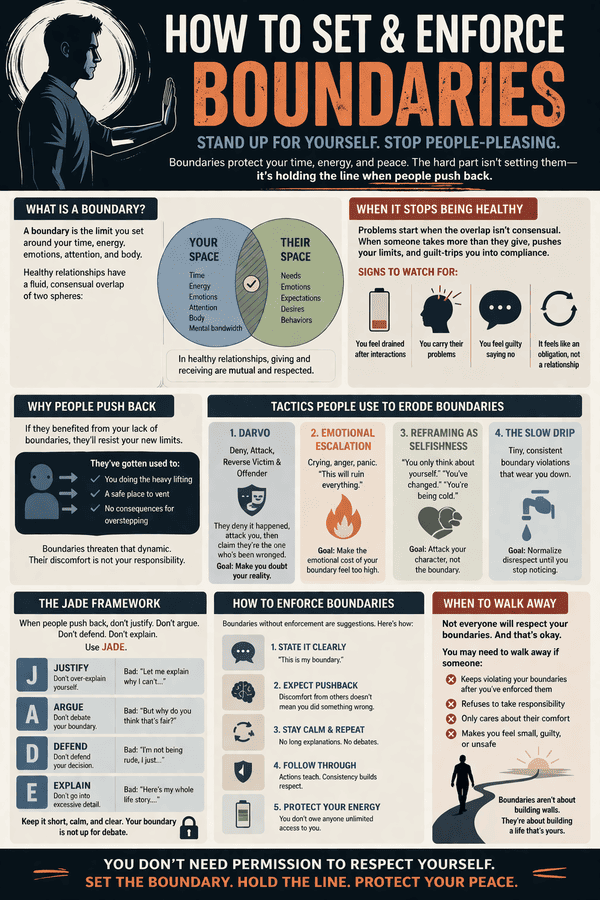
Before we talk about enforcing boundaries, we need to be very clear on what a boundary actually is. There’s a lot of talk about them but very few people yet have a clear-cut definition of it. Chernata (2024) tells us that “personal boundaries, or limits, refer to the internal boundaries that an individual establishes for themselves in their interactions with the surrounding world and other people.”
A useful way to understand it is through two spheres.
- One sphere is your space: your time, your energy, your emotions, your attention, your body, your mental bandwidth.
- The other sphere is the other person’s space: their needs, emotions, expectations, desires, and behaviors.
In any interaction, these spheres come into contact.
That’s normal.
In healthy relationships, there’s a fluid, consensual overlap:
- You give time because you want to
- You listen because you choose to
- You help because it feels aligned
- The exchange goes both ways
There is movement between spheres, but it’s mutual and regulated. Both parties win in this case.
When It Stops Being Healthy
Problems start when that overlap stops being consensual. When one side doesn’t negotiate, doesn’t reciprocate, just pushes further and takes.
What that looks like in practice: someone who demands more of your time than you agreed to give. Who asks you to carry things that aren’t yours to carry. Who guilt-trips you into saying yes when every part of you wants to say no, and then acts confused or offended when you finally try to name what’s happening. Over time you notice that you’re consistently leaving interactions feeling drained, resentful, or somehow responsible for their emotional state.
This is a slow leak. If it goes unaddressed long enough, it stops feeling like a relationship and starts feeling like an obligation you can’t get out of.
Why People React So Strongly When You Set Boundaries
This is a hard truth about boundaries:
The people who benefited the most from your lack of boundaries are the ones most likely to get pissed off when you create them.
Imagine: the other person has taken up a lot of space. They have their sphere, and extra too! They have someone that does the heavy lifting for them, a punching bag for them to vent to when they feel irritated that doesn’t yell back, a place they can go to that no matter how much that person gets mistreated, they don’t go away.
When boundaries are set, they stand to lose all that. They won’t like that. Chances are they won’t magically reflect on the nature of their treatment, recognize their own faults and accept your new limits (if they had the capacity to do that, we wouldn’t be here in the first place) so instead, they’ll push back.
And they’ll use many creative ways of doing so. They’ll use guilt. They’ll reframe your boundary as an attack. They’ll act wounded, confused, or suddenly very fragile. They’ll tell you you’ve changed, that you’re being selfish, that this isn’t who you used to be. All of which is true, in a way. You are changing. That’s the point.
However, if you learn about some of them and can regulate your emotions enough so they don’t make you backpedal, they will have to accept the new terms and you’ll now enjoy way more freedom and energy than before.
The Tactics People Use to Erode Boundaries
Once a boundary is stated, the negotiation begins, whether openly or psychologically. This is what you should look for so you don’t get pulled off course.
1. DARVO
Deny, Attack, Reverse Victim and Offender
It goes like this: first they deny it ever happened. Then they turn it back on you. Then, somehow, they’re the one who’s been wronged. Suddenly you’re not holding a boundary anymore. You’re defending yourself in a trial you never intended to attend, trying to prove that your experience was real while they question your memory, your tone, your intentions.
It’s disorienting by design.
2. Emotional Escalation
If calm pressure doesn’t work, the intensity goes up. Crying, anger, panic. “This is going to ruin everything.” “I can’t believe you’re doing this to me.”
The goal, often unconscious, is straightforward: make the emotional cost of the boundary high enough that removing it feels like relief. And it works, because most people with boundary difficulties already have a hard time tolerating someone else’s distress, especially when they’re being framed as the cause of it.
3. Reframing Your Boundary as Selfishness
This one is probably the most effective, because it doesn’t attack the boundary directly. It attacks you.
“You only think about yourself.” “Relationships require sacrifice.” “You’re being cold.” “You’re not the person I thought you were.”
The conversation is no longer about your limit. It’s about your character. And this is effective because a lot of “people pleasers” are genuinely good people. They are kind, generous, cooperative, want others not to suffer and are willing to negotiate and compromise. And when they are (wrongly) accused of being the opposite way, they can feel very distressed about it.
DARVO tactics are so prevalent that they are even being studied at length during court cases (Amtoft, 2024) to help people navigate those situations better.
A Very Important Reframe: The Reaction Is Information
When a reasonable boundary is met with:
- Rage
- Manipulation
- Guilt
- Punishment
- Withdrawal of love
- Victimhood
You are learning something extremely important about the relationship:
The relationship may have been functioning on your over-functioning.
Your boundary is not creating the problem. Rather, it’s revealing one.
Read that again, because this is the part people forget when the pressure starts.
Don’t Get Pulled Into the JADE Loop
When people push against a boundary, many fall into what’s called JADE:
- Justify
- Argue
- Defend
- Explain
You have set a boundary. The other person attacks it somehow. And then you start like this:
- “I can’t come because I’m really tired and I had a long week and my therapist says I need rest and I’ve been overwhelmed and…”
- “I didn’t answer because I was busy and my phone died and I had work and…”
- “I don’t want to lend money because I’m saving and the economy and…”
The problem is:
JADE turns a boundary into a debate.
And the more you explain, the more material the other person has to argue with. They can start picking apart your excuses, bring in more things that have little to do with the situation itself, have more things to use against you.
Compare:
JADE version:
“I can’t help you move because I have a lot of work, I’m really stressed and I need to rest, and I also have to wake up early…”
Boundary version:
“I can’t help you move this weekend.”
Silence is uncomfortable. That’s fine, cause once you get accustomed to it, you won’t have a problem ever again.
It is also what makes the boundary real.
What It Costs to Abandon a Boundary
People often talk about the potential cost of setting boundaries. Examples are potential distance or the cessation of the relationship. Feeling awkwardness and discomfort, fearing confrontation, or feeling like one is being the bad guy.
But fewer people talk about the cost of not having boundaries:
- Resentment
- Emotional exhaustion
- Feeling used
- Loss of self-respect
- Passive-aggressive behavior
- Burnout
- Staying in relationships that only work when you disappear
- Becoming someone you don’t like because you’re always betraying yourself
Every time you abandon a boundary to keep the peace, you create more problems inside of you.
And long term, that war WILL take its toll as anxiety, irritability, numbness, or depression.
Final Thoughts
Boundaries don’t tell people what they can do, they tell people what you will do.
This is an excellent way to understand boundaries.
A boundary is not:
- “You have to stop yelling”
- “You have to respect me”
- “You have to understand”
A boundary is:
- “If you keep yelling, I will leave the conversation.”
- “If this continues, I won’t be able to keep working together.”
- “If you speak to me like this, I’m going to hang up.”
- “If you don’t pay me back, I won’t lend money again.”
And actually follow through.
For example, I was working with a recently separated father who described how, during child drop-offs, his ex-partner would find ways to keep him there—cooking for him, initiating emotional conversations, or raising issues in the moment. He often ended up staying longer than intended, canceling plans, and leaving feeling confused.
So what he tried after talking to me was on one occasion to let her know in advance that he had dinner plans. Then when she tried to engage him again, offering food, then pleading, then asking if he was angry at her. He simply said, “Remember I told you I have a dinner.”, then “Sorry, I’m being expected.” And finally, “Everything’s cool, I need to go now, bye”. He stayed on point and did what he said he would do, which was to go and have dinner elsewhere. In session, we noted that what changed was not the explanation, but his ability to hold the boundary without entering the discussion.
A boundary is an if–then statement about your behavior, always follow through.
Because people learn your boundaries not when you say them, but when you enforce them.
Let me say that again: people learn when actual consequences happen.
Not when you explain things for the tenth time.
Or when you justify them.
Or when you hope they understand why you have those limits.
Only when you enforce them.
A phrase I really like goes like this: “The definition of insanity is doing the same thing over and over again, but expecting different results.”
True change only comes when our actions change as well. Don’t let them walk over you anymore.
References:
Amtoft, L. M. (2024). The Prevalence of DARVO in High-Conflict, Custodial Litigation and its Subsequent Impact on Protective Parents (Doctoral dissertation, Alliant International University).
Chernata, T. (2024). Personal boundaries: definition, role, and impact on mental health. Personality and Environmental Issues, 3(1), 24-30. https://doi.org/10.31652/2786-6033-2024-3(1)-24-30