

Table of Contents
Affiliate link notice: As an affiliate of BetterHelp and other third-party vendors, we may receive compensation if you make a purchase using the links provided on this page. For more information, visit our disclosure page.
Last Updated on September 2, 2026 by Randy Withers
You’ve been here before.
It’s 11 p.m., and your phone buzzes with a message from your son—he’s short on rent again. Three weeks into treatment, and now this. You know what the money might be used for. You also know that if he loses his apartment, he might disappear entirely.
So you transfer the funds.
And then you lie awake, asking yourself the question that quietly haunts so many parents in this position:
Did I just help him—or did I just make things worse?
Or maybe it’s something more subtle. You call their employer and say they’re sick. You smooth things over with relatives. You tell yourself it’s temporary—just until things stabilize.
These moments—private, emotionally charged, and often invisible to others—are where the real struggle lives.
The line between support and enabling.
And it is one of the most difficult lines a parent will ever have to navigate.
The guilt. The fear. The instinct to protect. None of these are weaknesses. They are the natural responses of a parent who loves their child deeply. But without clarity, those same instincts can quietly lead to decisions that prolong the very problem you’re trying to solve.
Understanding where support ends and enabling begins is not just important—it is foundational to long-term recovery.
Addiction Affects the Whole Family
Addiction is often described as a “family disease”—not because families cause it, but because they are profoundly affected by it. Over time, substance use disorders reshape the emotional and behavioral patterns of an entire household.
Parents may become hypervigilant, constantly scanning for warning signs. Conversations become guarded. Daily routines shift around crisis management. Emotional bandwidth narrows.
Organizations like the American Society of Addiction Medicine (ASAM) and the Substance Abuse and Mental Health Services Administration (SAMHSA) emphasize that recovery is not an individual process—it unfolds within a broader family system that both influences and is impacted by the disorder.
Alongside these changes, many parents carry a quiet but persistent sense of guilt:
Did I miss something? Did I contribute to this?
This emotional burden can distort judgment in subtle ways. Love, when mixed with fear, can blur boundaries. And over time, those blurred boundaries can become patterns that are difficult to recognize, let alone change.
Understanding the Enabling Trap
Enabling is not neglect. It is not indifference. It is almost always rooted in love.
But there is a critical distinction that matters:
Enabling is any behavior that removes the natural consequences of substance use in a way that makes continued use easier.
This can include:
- Paying rent, debts, or providing money without connection to recovery
- Making excuses to employers, schools, or extended family
- Avoiding difficult conversations out of fear of triggering conflict
- Allowing substance use in the home “to keep the peace”
- Providing comfort that removes the discomfort needed for insight and motivation
These behaviors often bring short-term relief—for both parent and child. They reduce immediate distress, stabilize the moment, and create a temporary sense of control.
But over time, they can reinforce the cycle of addiction.
The Diagnostic and Statistical Manual of Mental Disorders, Fifth Edition (DSM-5) describes substance use disorders as patterns maintained in part by reinforcement cycles—where relief from distress (including the avoidance of consequences) strengthens continued use. When consequences are consistently softened or removed, the urgency to change can be delayed.
This is not about blame. It is about understanding how deeply human instincts—protecting, rescuing, soothing—can sometimes work against long-term recovery.
Why This Line Is So Hard to See
One of the most common thoughts parents experience is:
“If I don’t help right now, something terrible will happen.”
And sometimes, that fear is grounded in reality. Addiction carries real risks—overdose, instability, legal consequences, or complete disconnection.
But here is the difficult truth:
Short-term relief and long-term recovery are often in direct conflict.
Each time a parent intervenes to prevent an immediate consequence, it may delay the moment when the full impact of the behavior becomes clear enough to motivate change.
Recovery research consistently shows that internal motivation—the individual’s own recognition that the cost of continued use outweighs the benefit—is one of the strongest predictors of sustained recovery. That recognition is often uncomfortable. It is often gradual. And it is frequently interrupted by well-intentioned rescue.
None of this is intuitive. It runs counter to every parental instinct.
Learning to tolerate that discomfort—to pause before stepping in—is one of the hardest and most important shifts a parent can make. The goal is not to withdraw support, but to reshape it in a way that aligns with recovery rather than short-term relief.
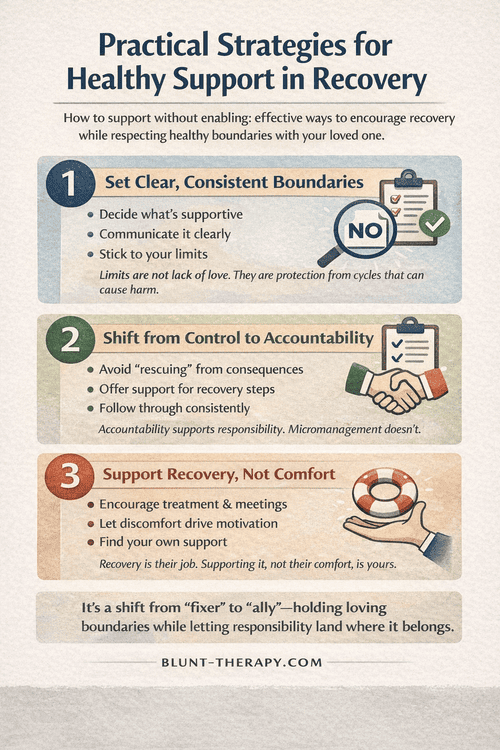
Three Practical Strategies for Healthy Support
These strategies are not about withdrawing love. They are about directing it more effectively—toward recovery rather than temporary relief.
Strategy 1: Set Clear, Consistent Boundaries
Boundaries are not punishments. They are not acts of rejection. They are clear statements of what you are able—and not able—to support.
Examples include:
- “I will help pay for treatment, but not for rent if you are not in treatment.”
- “You are welcome in our home, but substances are not allowed.”
- “I cannot provide financial support that is not connected to your recovery.”
- “I will not provide bail money if substance use is involved.”
Note: In situations involving legal or safety risks, these decisions should be made thoughtfully and, when possible, in consultation with clinical or legal professionals.
The effectiveness of a boundary is not determined by how strict it is—but by how consistently it is maintained. Inconsistency creates confusion. Consistency creates structure.
Strategy 2: Shift from Control to Accountability
One of the most painful realizations for parents is this:
You cannot control recovery.
You cannot force insight, readiness, or change. But you can support accountability.
This means:
- Allowing natural consequences when they are not life-threatening
- Avoiding rescue behaviors that interrupt the learning process
- Avoiding cover-ups that protect your loved one from the reality of their situation
- Encouraging your loved one to develop sustainable coping strategies to support their own recovery.
- Following through on what you say, even when it is uncomfortable
This is not abandonment. It is a shift from controlling outcomes to supporting responsibility.
Strategy 3: Support Recovery, Not Comfort
There is a meaningful difference between providing emotional support and removing discomfort.
You can be present, caring, and deeply supportive—while still allowing your loved one to experience the natural challenges of recovery.
Support recovery by:
- Helping them access structured, evidence-based treatment
- Encouraging therapy and peer support engagement
- Participating in family therapy when appropriate
- Recognizing and reinforcing genuine recovery efforts
Standards from organizations like The Joint Commission highlight the importance of structured, quality care environments in improving outcomes. Families play an important role—but they are not a substitute for treatment systems.
Reframing Your Role: From Fixer to Ally
Many parents operate from a deeply understandable belief:
“If I just try hard enough, I can fix this.”
But this belief can lead to over-functioning—taking on responsibilities that ultimately belong to the person in recovery.
A more sustainable and effective framework is this:
Your role is not to fix the problem, but to create conditions in which change becomes possible.
This includes:
- Maintaining your own emotional stability
- Modeling boundaries and accountability
- Staying connected without becoming enmeshed
- Seeking support for yourself—through therapy, family counseling, or peer support groups such as Al-Anon or SMART Recovery Family & Friends
Family therapy, in particular, can be a powerful tool—not just for your loved one, but for the family system as a whole. Many treatment programs offer family involvement as a core component of care, and SAMHSA guidelines recognize family engagement as a key element of recovery-oriented systems of support.
Recovery is ultimately driven by the individual. Families can influence that process—but they cannot carry it.
From Fixing to Empowering
Love and limits are not opposites.
You can care deeply and still say no.
You can be present and still hold boundaries.
You can support recovery without removing every obstacle.
The discomfort you feel when holding that line is not a sign that you are doing something wrong. It is often a sign that you are doing something difficult—and necessary.
Recovery requires discomfort. Growth lives there.
You are not alone in this. And while the line may be invisible, learning to hold it—with clarity, consistency, and compassion—can make all the difference.
For a deeper, practical guide on putting these principles into practice, see: How to Support a Loved One in Recovery Without Enabling
Clinical & Educational Frameworks Referenced
- American Society of Addiction Medicine (ASAM) — Definition of Addiction and Family Impact
- Substance Abuse and Mental Health Services Administration (SAMHSA) — Family Systems and Recovery-Oriented Systems of Support
- American Psychiatric Association — Diagnostic and Statistical Manual of Mental Disorders, Fifth Edition (DSM-5)
- The Joint Commission — Standards for Behavioral Health Care and Human Services