
Table of Contents
Affiliate link notice: As an affiliate of BetterHelp and other third-party vendors, we may receive compensation if you make a purchase using the links provided on this page. For more information, visit our disclosure page.
Your breath already has a rhythm. When you guide that rhythm intentionally, you send your nervous system a clear signal that you are safe. Rhythmic breathing builds on something automatic and turns it into a tool you can use to steady your mood, sharpen your focus, and feel more grounded.
It’s simple, but not trivial. Small shifts in how you breathe can change how your body responds to stress, how quickly you recover from it, and how present you feel in your day-to-day life.
What Is Rhythmic Breathing?
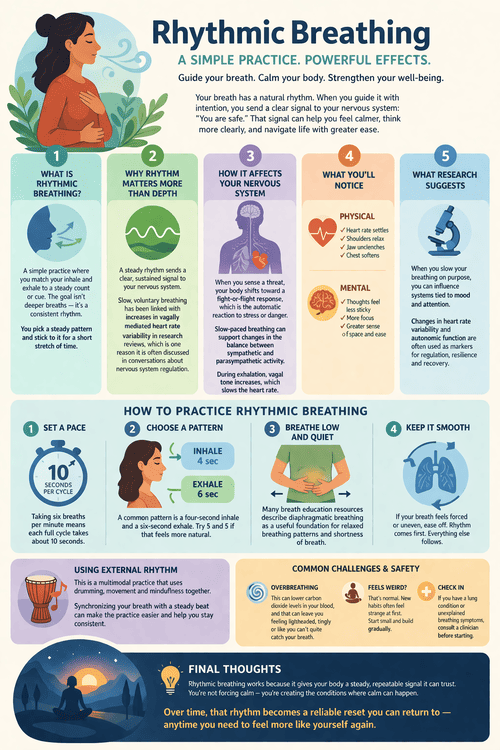
Rhythmic breathing is built on consistency more than effort. You pick a steady pattern and stick to it for a short stretch of time. The goal is not to force bigger breaths, but to create a predictable pace your body can settle into.
You’ll see this used in yoga, tai chi, and meditation, but it’s just as useful in ordinary moments—at your desk, in your car, before a difficult conversation, or lying in bed when your mind won’t slow down.
At its core, rhythmic breathing means matching your inhale and exhale to a count or cue. Beginners could try a four-count inhale and a six-count exhale repeated for two to five minutes. At first, the counting may feel distracting, but that usually fades as your attention adjusts.
Why Rhythm Matters More Than Depth
Many people assume deeper breathing is better breathing. In practice, rhythm does most of the work.
A steady pattern gives your nervous system a clearer and more sustained signal than a single deep breath ever could. Slow, voluntary breathing has been linked with increases in vagally mediated heart rate variability in research reviews, which is one reason it is often discussed in conversations about nervous system regulation. Put simply, consistent breathing patterns help your body shift toward a calmer, more regulated state.
There’s also a practical side. When people chase depth, they often end up forcing the breath or unintentionally speeding it up. Rhythm keeps things smooth. It lowers the chance of overthinking the process—and makes it easier to keep going.
How Rhythmic Breathing Affects Your Nervous System
Your nervous system is constantly adjusting based on what it thinks is happening around you. When you sense a threat, your body shifts toward a fight-or-flight response, which is the automatic reaction to stress or danger. That response is useful when you need it—but not when you’re trying to relax, focus, or wind down.
Breathing sits in a unique position. It happens automatically, but you can also guide it.
Slow-paced breathing can support changes in the balance between sympathetic and parasympathetic activity. In everyday terms, that means helping your body move out of high alert and into a more settled state.
The exhale is especially important. During exhalation, vagal tone increases, which slows the heart rate. A slightly longer, smoother exhale often feels calming because it directly supports that shift.
What You’ll Notice in Your Body and Mind
You don’t need a device to tell you it’s working. Your body gives feedback quickly.
Your heart rate may settle within a minute or two. Your shoulders drop without effort. Your jaw unclenches. That tight feeling in your chest softens.
Mentally, there’s often more space. Thoughts don’t disappear, but they feel less sticky. Your attention widens. You’re still aware—but not pulled in as tightly.
What Research Suggests About the Benefits of Rhythmic Breathing
The research around slow breathing consistently points in the same direction. When you slow your breathing on purpose, you can influence systems tied to mood and attention.
These effects are often measured through changes in heart rate variability and autonomic function—both indicators of how well your body regulates stress and recovers from it. In practical terms, this means rhythmic breathing can help you settle faster and regain clarity more quickly after tension builds.
How to Practice Rhythmic Breathing
This is a skill, not a performance.
Taking six breaths per minute means each full cycle takes about 10 seconds. A common pattern is a four-second inhale followed by a six-second exhale, though a five-and-five rhythm may feel more natural at first.
Keep the breath low and quiet. Many breath education resources describe diaphragmatic breathing as a useful foundation for relaxed breathing patterns and shortness of breath. That means letting your abdomen expand gently instead of lifting your shoulders.
If the breath becomes forced or uneven, that’s your signal to ease off. Rhythm comes first. Everything else follows.
Using External Rhythm to Support Breathing
For some people, internal focus is difficult to sustain. External rhythm can help.
This is a multimodal practice that uses drumming, movement and mindfulness together. By syncing your breath with a steady external beat, you give your attention something concrete to follow. That reduces the urge to monitor the breath and can make the experience feel more natural.
Common Challenges and Safety Considerations
Rhythmic breathing should feel steady and manageable. If it becomes intense, treat that as information and adjust.
Overbreathing is the most common issue. It happens when you take in too much air or speed up without noticing. This can lower carbon dioxide levels in your blood, and that can leave you feeling lightheaded, tingly or like you can’t quite catch your breath. If that happens, slow down and return to a gentler pattern.
You may also notice that the practice feels unfamiliar at first. That’s normal. New body habits often feel strange before they feel natural. Keep sessions short and build gradually.
If you have a lung condition or unexplained breathing symptoms, it’s worth checking with a clinician before starting a structured practice.
Final Thoughts
Rhythmic breathing works because it gives your body something it can recognize and respond to—a steady, repeatable signal.
You’re not forcing calm. You’re creating the conditions where calm can happen.
Over time, that rhythm becomes more than a technique. It becomes a reliable reset you can return to—whether you’re overwhelmed, distracted, or simply trying to feel a little more like yourself again.