

Table of Contents
Affiliate link notice: As an affiliate of BetterHelp and other third-party vendors, we may receive compensation if you make a purchase using the links provided on this page. For more information, visit our disclosure page.
Last Updated on May 2, 2026 by Randy Withers
In the world of professional counseling, couples often say they are “bad at communicating.” They come in after a week of bickering, each holding a list of what the other person did wrong.
But more often than not, the issue isn’t communication skills. It’s a lack of awareness of their partner’s biological state—and a lack of co-regulation, the process by which one person’s calm nervous system helps settle another’s.
In the middle of conflict, most people try to force a conversation when their partner is emotionally depleted.
This is what I call the “Empty Tank” trap. To avoid it, we need to understand how co-regulation works and how it can transform an ordinary Tuesday night blowup into a moment of secure connection.
The Anatomy of a Tuesday Night Blowup
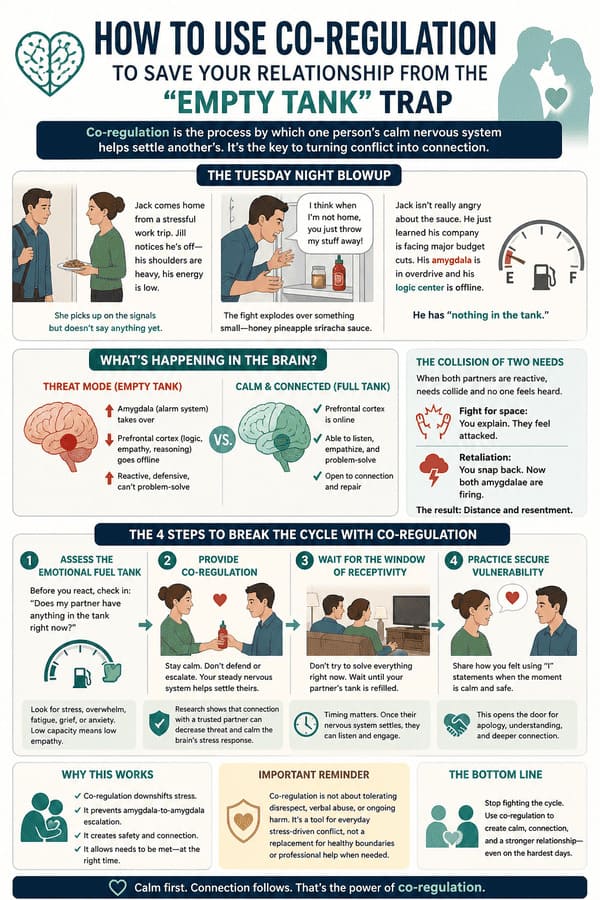
To see how this plays out, consider a common scenario involving a couple we’ll call Jack and Jill. They’ve been married for five years. Jack travels frequently for work, while Jill works a steady 9-to-5.
On this particular Tuesday, Jack has just returned from a long trip. Jill is already home and has prepared dinner. When they greet each other, nothing seems obviously wrong—but Jill notices a heaviness in Jack’s shoulders.
She senses something is off, even if she doesn’t yet know why. This kind of “pre-check” is critical, but in many relationships, these signals are overlooked.
The conflict eventually erupts over something trivial: a missing bottle of honey pineapple sriracha sauce. As Jack searches the fridge, his frustration peaks. He snaps, “I think when I’m not home, you just throw my stuff away.”
What Is Actually Happening in the Brain?
When Jack snaps, he isn’t really reacting to the sauce. Earlier that day, he learned his company was facing major budget cuts.
He’s experiencing what’s often referred to as an amygdala hijack—a stress response where the brain prioritizes threat detection over thoughtful processing.
In this state, the amygdala (the brain’s alarm system) becomes highly active, while the prefrontal cortex—responsible for empathy, reasoning, and impulse control—has significantly reduced influence.
Jack effectively has “nothing in the tank.” His capacity for patience and perspective is limited in that moment. If Jill responds with anger, she’s attempting a logical conversation with someone whose ability to engage logically is temporarily compromised.
The Collision of Two Needs
This is where most relationships break down.
Jill has every reason to feel hurt. She worked all day, made dinner, and is now being criticized. If she follows her natural impulse to defend herself, the situation escalates into what I call a “collision of needs.”
This often looks like:
Fighting for Space: Jill explains herself. Jack, still in a heightened state, interprets it as an attack.
Retaliation: Jill responds with frustration. Now both partners are reactive, and the night ends in a standoff.
This happens because both people are trying to meet their needs at the same time—but the system is already overwhelmed. There’s no capacity for both.
Step 1: Assess the Emotional Fuel Tank
The first step is simple, but not easy: assess.
Before reacting, ask:
“Does my partner have anything in the tank right now?”
“Tank” refers to emotional and physiological capacity—the ability to regulate, empathize, and engage constructively.
If your partner is dealing with stress, grief, or anxiety, that capacity may be low. Jill recognized this early. She saw the signs before the conflict escalated.
Step 2: Provide Co-Regulation
Instead of engaging in the argument, Jill chose co-regulation.
She didn’t defend herself or escalate. She calmly moved a few items in the fridge, found the sauce, and handed it to him.
Her nervous system stayed steady.
That steadiness matters. Research, including work by Dr. James Coan, has shown that connection with a trusted partner—sometimes as simple as physical presence or touch—can reduce perceived threat and calm the brain’s stress response.
Jill’s response functioned as a kind of “biological handhold.” She signaled safety rather than threat, allowing Jack’s system to settle.
Step 3: Wait for the Window of Receptivity
One of the most common mistakes couples make is trying to resolve everything immediately.
Jill understood timing. She allowed the moment to pass and revisited it later, once Jack had eaten, relaxed, and talked through his work stress. His system had settled. His “tank” was no longer empty.
Step 4: Practice Secure Vulnerability
Later that evening, Jill said:
“I didn’t appreciate what you said earlier. It hurt me, and I didn’t feel like I deserved that.”
Now Jack could hear her.
He responded with accountability:
“You’re right. I’m sorry. I was upset about work.”
This is the difference co-regulation creates. It makes space for repair.
Why This Works: The Power of Secure Connection
Jill’s response wasn’t about suppressing her needs or becoming a “doormat.” It was about sequencing them effectively.
In a secure relationship, partners trust that their needs will be addressed—just not always in the heat of the moment.
That trust allows one person to be the stabilizing force temporarily, knowing the roles will shift when needed.
It’s important to be clear: this approach is not about tolerating ongoing disrespect, emotional harm, or abusive behavior. It applies to everyday stress-driven conflict—not patterns of harm that require stronger boundaries or professional intervention.
Final Thoughts: Stop Fighting the Cycle
Resentment builds when needs go unmet—but often, they go unmet because they’re expressed at the wrong time.
By using co-regulation, assessing the “Empty Tank,” and respecting timing, couples can move from reactive conflict to intentional connection.
The next time your partner snaps, pause. Look for the state behind the behavior. Offer stability first. Then, when the moment is right, ask for what you need.
That’s how relationships don’t just survive stress—they grow through it.