Table of Contents
Affiliate link notice: As an affiliate of BetterHelp and other third-party vendors, we may receive compensation if you make a purchase using the links provided on this page. For more information, visit our disclosure page.
Last Updated on April 12, 2026 by Randy Withers
Most people with insomnia eventually arrive at the same conclusion:
If I just try harder, I’ll finally fall asleep.
That sounds reasonable. It’s also exactly what makes the problem worse.
At night, the mind starts running ahead—I have work tomorrow… I only have a few hours left… what if I don’t sleep at all? What begins as concern quickly escalates into pressure. The body responds accordingly. Heart rate rises. Muscles tighten. The brain shifts into a state of alertness that is fundamentally incompatible with sleep.
This is the core of insomnia anxiety. The brain is not failing to sleep—it is doing something else very well. It is staying alert. And in that state, even the act of trying to fall asleep can be misinterpreted as something that requires effort, control, and vigilance.
From the outside, it looks like a paradox. The more exhausted someone feels, the harder they try to sleep. The harder they try, the more awake they become. Over time, this pattern stops feeling temporary and starts feeling personal—as if something is broken.
It isn’t.
What’s actually happening is a feedback loop. Sleep becomes something to manage, monitor, and get right. The bed becomes a place where attention sharpens instead of softening. And the mind, instead of letting go, stays engaged—watching, calculating, waiting.
This article breaks that cycle down. Not just why insomnia anxiety builds, but how it turns sleep into a performance—and what actually helps interrupt that pattern.
What Is Insomnia, Really?
Insomnia is often described as a problem with sleep. In practice, it is more accurate to think of it as a problem with wakefulness showing up at the wrong time.
Most people with insomnia are not lacking the ability to sleep. They still feel tired. They still have periods where sleep comes more easily. What changes is the relationship between the mind, the body, and the conditions required for sleep to occur.
Under normal circumstances, sleep is not something that needs to be forced. It emerges when the nervous system shifts out of a state of alertness and into one of relative calm. That transition is automatic—unless something interferes with it.
This is where insomnia anxiety becomes relevant. When the brain begins to associate the night, the bed, or even the idea of sleep with pressure, uncertainty, or frustration, it increases vigilance. The body responds accordingly, activating the same systems that would normally prepare someone to respond to challenge.
Over time, this becomes conditioned. The bed is no longer just a place for rest—it becomes a place where the mind anticipates effort. The moment someone lies down, attention sharpens. Thoughts become more active. The body prepares, not to sleep, but to monitor whether sleep is happening.
These patterns are well understood in Cognitive Behavioral Therapy for Insomnia (CBT-I), which is considered the most effective non-medication treatment for chronic insomnia. From that perspective, insomnia is not just the absence of sleep. It is the presence of a system that has learned, often unintentionally, to stay awake.
Why Trying to Sleep Can Make Insomnia worse
At some point, most people with insomnia notice a frustrating pattern: the more effort they put into falling asleep, the less successful they become.
This isn’t a coincidence, and it isn’t a failure of willpower. It reflects a shift in how the brain and body are responding to sleep itself. What begins as a reasonable attempt to fix the problem gradually turns into a cycle of pressure, monitoring, and increasing alertness. Sleep, which normally happens automatically, becomes something that feels like it has to be managed.
The sections below break down the key mechanisms that drive that cycle. While they may show up differently from person to person, they tend to follow a similar pattern—and they are all closely tied to the same underlying process: insomnia anxiety.
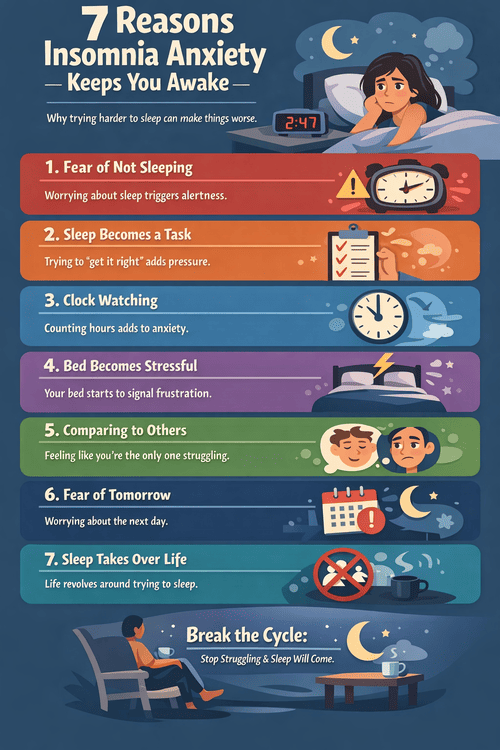
1. Insomnia Anxiety: When the Brain Treats Sleep Like a Threat
For many people, insomnia does not begin with the absence of sleep—it begins with the fear of not sleeping.
The thoughts are familiar. I have work tomorrow. I only have a few hours left. What if I can’t function? On the surface, these seem like reasonable concerns. But at night, they carry urgency.
And the brain responds accordingly.
When that urgency builds, the nervous system shifts into a more activated state. Heart rate increases. Muscles tighten. Attention sharpens. This is not a malfunction—it is the same system that prepares the body to respond to challenge. The problem is that sleep requires the opposite state.
This is the core mechanism behind insomnia anxiety. The brain begins to treat sleep as something that must be achieved under pressure, rather than something that emerges when pressure decreases. Over time, it stops distinguishing between actual threat and the internal tension created by trying to control sleep.
The harder someone tries to sleep, the more the brain interprets that effort as a signal that something is wrong. That interpretation leads to increased alertness. And increased alertness makes sleep less likely.
What looks like a paradox is actually a feedback loop.
- Effort increases pressure.
- Pressure increases alertness.
- Alertness prevents sleep.
- And the absence of sleep increases effort again.
2. Sleep Becomes a Performance Task
Once insomnia anxiety takes hold, sleep often stops feeling like a natural process and starts to resemble a task that needs to be completed correctly.
Routines become rigid. The environment is adjusted repeatedly—temperature, lighting, timing, supplements, devices. Each step is intended to improve sleep, but together they can create a sense that something must be done exactly right for sleep to happen.
At that point, the process starts to feel less like winding down and more like preparation for an outcome that cannot be controlled directly.
Some people describe it as moving through a checklist. The structure itself is not the problem. The pressure attached to it is.
Because once sleep becomes something that must be achieved, attention shifts. Instead of drifting, the mind begins to monitor. Is this working? Am I relaxed enough? Why am I still awake?
And that monitoring keeps the system engaged.
Sleep does not respond well to performance pressure. It is not something that improves with effort alone. In fact, the more it is treated like a task, the less accessible it tends to become.
3. The Clock-Watching Trap
Time becomes a problem very quickly.
Many people with insomnia find themselves checking the clock repeatedly, calculating how many hours remain before morning. If I fall asleep now, I can still get five hours. Then four. Then less.
Each calculation adds pressure. Sleep becomes tied to a shrinking window, and the urgency increases with every passing minute.
At the same time, attention turns inward. People begin scanning for signs of sleep. Do I feel tired yet? Are my eyes heavy? Why am I still awake?
This is where insomnia anxiety tightens its grip. Monitoring replaces the ability to drift. The more closely someone watches for sleep, the more alert they become.
Trying to force sleep by watching for it is like trying to step on your own shadow—it keeps moving just out of reach.
4. The Bed Becomes Associated With Stress
Over time, the brain begins to form associations.
If someone repeatedly lies in bed feeling frustrated, anxious, or alert, the bed itself can start to trigger that state. Instead of signaling rest, it signals effort.
People often notice this clearly. They may feel calm during the day, even tired. But as soon as they get into bed, something changes. Their mind becomes more active. Their body feels more tense.
This is not random. It is learned.
The brain has linked the bed with wakefulness and pressure. In CBT-I, one of the most effective strategies is to break that association. If you are unable to fall asleep after a period of time, it is often recommended to get out of bed and return only when you feel sleepy. This helps retrain the brain to associate the bed with sleep rather than wakefulness.
5. The Comparison Trap
Sleep is one of the few things people tend to compare without realizing it.
Someone falls asleep in minutes. Another lies awake for hours. The difference feels personal.
People with insomnia often start to question themselves. Why is this so easy for them? What am I doing wrong? That line of thinking introduces frustration, and often shame.
What gets overlooked is simple but important. People who sleep well are not trying to sleep. Their attention is not fixed on the process. They are not monitoring, calculating, or correcting.
The comparison creates a false conclusion—that others have something you lack. In reality, they are simply not engaged in the same cycle.
6. Fear of Tomorrow
Nighttime thoughts rarely stay in the present.
Instead, they move forward. How will I function tomorrow? Will people notice? What if I make mistakes?
These thoughts are understandable. But they add another layer of pressure.
Now, sleep is tied to performance and competence. That raises the stakes, which increases alertness.
Many people function better than expected, even after a poor night of sleep. But insomnia anxiety tends to magnify the anticipated consequences, making them feel more certain than they actually are.
7. When Sleep Becomes the Center of Your Life
At a certain point, sleep can start to take over.
People begin adjusting everything around it—cutting out activities, limiting social time, avoiding things they enjoy, all in an effort to improve sleep. They research constantly. They try new strategies. They monitor every variable.
The intention is understandable. But the effect is often the opposite.
When sleep becomes the central focus, it carries more weight. More importance. More pressure.
And with that pressure, insomnia anxiety deepens.
What Actually Helps Break the Cycle
If effort and control are part of the problem, the solution is not to try harder—it is to change the relationship with sleep.
This does not mean doing nothing. It means shifting away from pressure-based strategies and toward conditions that allow the nervous system to settle.
In CBT-I, several principles are used to help interrupt the cycle. These include reducing time spent awake in bed, maintaining a consistent wake time, and gradually rebuilding the association between the bed and sleep. One component, often referred to as sleep restriction or sleep compression, involves aligning time in bed more closely with actual sleep to strengthen that connection.
Just as important is reducing performance pressure. This means allowing periods of wakefulness without escalation, stepping away from constant monitoring, and focusing less on whether sleep is happening in real time.
Comfort-based activities can also help—reading, listening to something calming, or engaging in a quiet routine that does not carry pressure. The goal is not to force sleep, but to create conditions where it can emerge.
Paradoxically, sleep tends to return when it is no longer treated as something that must be achieved.
Final Thoughts
Insomnia is frustrating because it feels like a problem that should respond to effort.
But sleep does not work that way.
The more pressure applied to it, the more the system resists. Not because something is broken, but because the brain is doing exactly what it has learned to do—stay alert when something feels important or uncertain.
This is the nature of insomnia anxiety.
Breaking that cycle is less about finding the perfect technique and more about both treating the cause of insomnia as well as breaking the pattern that keeps reinforcing it. When the pressure decreases, when monitoring slows, and when the body begins to feel more at ease, sleep has a chance to return.
Not because it was forced. But because it was finally allowed.