Table of Contents
Affiliate link notice: As an affiliate of BetterHelp and other third-party vendors, we may receive compensation if you make a purchase using the links provided on this page. For more information, visit our disclosure page.
Last Updated on April 14, 2026 by Randy Withers
Most people think of stress as something happening in their mind. In reality, it’s something happening in their body.
Deadlines pile up. Notifications don’t stop. Your attention is constantly pulled in different directions. Over time, your system adapts to that pressure by staying alert—sometimes long after the situation actually requires it. What starts as a normal response to stress can begin to feel constant.
This is where the idea of a regulated nervous system becomes important.
When your nervous system is well regulated, it can shift in and out of stress as needed. You can focus when something demands your attention and settle when it passes. When it’s dysregulated, that flexibility starts to break down. The body stays on edge longer than it should, or struggles to fully settle at all.
The techniques in this article are designed to help your system shift more reliably. Some work in the moment, while others support longer-term patterns that make it easier to return to a more regulated nervous system over time.
What Is the Nervous System and Why Does It Matter?
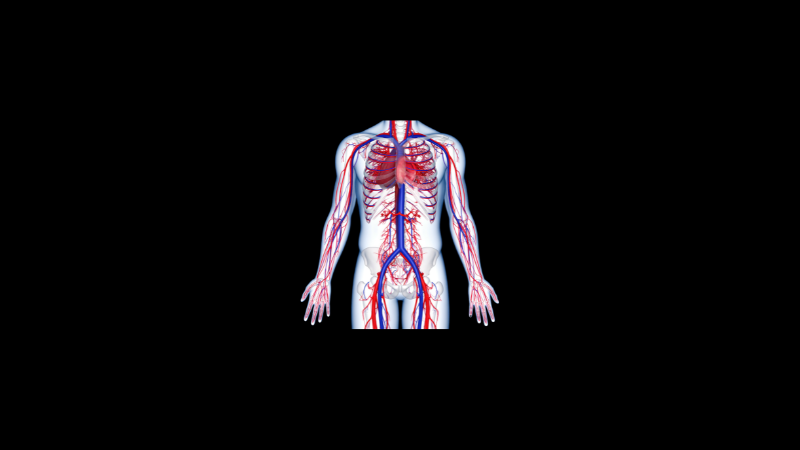
Your nervous system is the control system that coordinates how your body responds to the world around you. It processes what you see, hear, and think, then determines how your body should react—often before you’re fully aware of it.
At a basic level, it operates through two primary states. One is designed for action. This is the fight-or-flight response, where your body becomes more alert, your heart rate increases, and your attention narrows. The other is designed for recovery. This is often referred to as a rest-and-digest state, where your body slows down, conserves energy, and supports processes like digestion and repair.
Both states are necessary. The problem arises when your system has difficulty shifting between them.
A regulated nervous system can move fluidly between activation and recovery depending on what the situation requires. A dysregulated system tends to get stuck. It may stay in a heightened state even when there is no immediate threat, or it may struggle to fully re-engage after stress has passed.
The techniques that follow are designed to support that shift. Rather than forcing calm, they work by giving your nervous system clear signals it can respond to—helping it move out of prolonged activation and back toward a more regulated state.
Signs of a Dysregulated Nervous System
As many as one in 18 American adults struggles with serious mental health issues that impede their daily living. For many, part of that experience includes patterns of nervous system dysregulation.
When your system becomes dysregulated, it tends to remain in a state of heightened alertness or, at times, shut down more than it should. This can happen even when there is no immediate threat in your environment.
The effects show up across multiple areas.
Emotionally, it can look like persistent anxiety, irritability, or sudden mood shifts. Some people feel constantly on edge, while others experience emotional numbness.
Cognitively, dysregulation often affects focus and clarity. You might notice racing thoughts, difficulty concentrating, or a tendency toward worst-case thinking that’s hard to interrupt.
Physically, the body reflects the same pattern. Fatigue, muscle tension, headaches, digestive discomfort, and dizziness are all common signals that the system is working harder than it needs to.
These symptoms are not random. They reflect a nervous system that has learned to stay activated or has difficulty returning to a more regulated nervous system state once stress has passed.
How to Calm Your Nervous System in the Moment
Mental health professionals may choose specific evidence-based therapeutic modalities such as cognitive behavioral therapy or mindfulness-based approaches to support long-term regulation.
In everyday situations, shorter techniques can help interrupt a stress response as it builds. These methods don’t instantly solve the underlying cause, but they can create a noticeable shift in how your body feels in the moment.
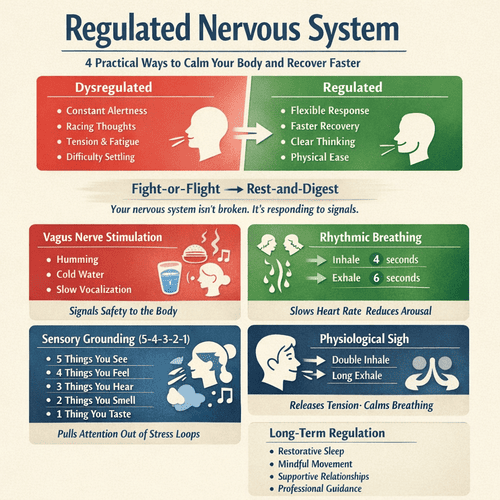
1. Activate the Vagus Nerve
Around 75% of the parasympathetic nervous system is composed of the vagus nerve. This system plays a central role in helping your body move out of a heightened state and into one that supports rest and recovery.
Simple activities like humming, singing, or gargling create subtle vibrations that can stimulate this pathway. Brief cold exposure, such as splashing your face with cool water, can also influence heart rate and create a calming effect.
These techniques work by engaging systems associated with slowing down and recovery, helping your body move toward a more regulated nervous system.
2. Practice Rhythmic Breathing
Breathing is one of the most direct ways to influence your internal state. Slowing and structuring the breath can reduce physiological arousal and support a shift out of high alert.
Box breathing is one structured approach. Do this by inhaling slowly through your nose for four seconds and then holding your breath for another four seconds. Then exhale for four seconds and hold again before repeating.
The value is in the consistency. A steady pattern gives your body a predictable rhythm, which can help reduce tension and support a more regulated nervous system over time.
3. Use Sensory Grounding
When your mind gets caught in loops—worry, rumination, worst-case thinking—it tends to pull your attention inward. The more attention stays there, the more intense the experience can feel.
Sensory grounding works by interrupting that pattern and redirecting attention outward.
The 5-4-3-2-1 technique is one of the most practical ways to do this. You move through your senses in a specific order:
- Name five things you can see
- Name four things you can feel (for example, the chair under you or your feet on the ground)
- Name three things you can hear
- Name two things you can smell
- Name one thing you can taste
This sequence gives your brain a structured task. Instead of continuing to feed internal stress signals, it shifts attention to real, present-moment input. This reduces the intensity of the thought loop and gives your nervous system different information to process—information that signals you are not in immediate danger.
The thoughts themselves may still be there, but they tend to feel less overwhelming. Attention widens, and your body has a chance to move toward a more regulated nervous system state.
4. The Physiological Sigh
The physiological sigh is a specific breathing pattern that can help reduce tension relatively quickly. It works by changing both the rhythm of your breathing and how gases are exchanged in the lungs.
The pattern is simple. You take a slow inhale through your nose, then take a second, shorter inhale to fully expand the lungs. After that, you follow with a long, slow exhale through your mouth.
In fact, practicing a five-minute sighing exercise every day has been associated with reductions in stress and improvements in mood over time.
What makes this effective is not that it “resets” your system instantly, but that it helps shift your breathing out of a shallow, rapid pattern and into a slower, more controlled one. That shift can influence heart rate and reduce overall physiological tension.
The extended exhale also plays a role. As your breath slows and lengthens, your body receives a signal that it can ease out of a heightened state. Over repeated cycles, that pattern can help move your system toward a more regulated nervous system.
Long-Term Strategies for Building a More Regulated Nervous System
Quick interventions can help in the moment, but they do not replace patterns that support regulation over time. A more regulated nervous system is usually built through repetition, recovery, and environments that reduce chronic strain rather than constantly reinforcing it.
Mindful Movement and Body Reconnection
Stress often pulls attention out of the body. People become mentally overactive while simultaneously less aware of what is happening physically until tension, fatigue, or irritability become too obvious to ignore.
Slow, intentional movement helps reverse that split. Practices like yoga, tai chi, and even deliberate walking ask you to notice breath, posture, pace, and physical sensation at the same time. That combination matters. It gives the nervous system a chance to experience movement without urgency and attention without overload.
The benefit is not just exercise. It is relearning that your body can be inhabited without always bracing for something.
Prioritizing Restorative Sleep
Sleep is one of the most important recovery processes the nervous system has. When sleep quality is poor, the system has fewer opportunities to reset, which makes stress responses easier to trigger and harder to resolve.
That is why sleep disruption and nervous system dysregulation often reinforce each other. Stress makes sleep harder. Poor sleep makes regulation harder the next day.
The basic supports still matter: a consistent sleep schedule, a wind-down period, and an environment that makes rest more likely. None of these are glamorous, but they are foundational. Over time, better sleep improves your odds of maintaining a more regulated nervous system, especially when combined with other supportive habits.
Nurturing Co-Regulation and Social Connection
Human beings regulate through relationships more than people often realize. The nervous system pays attention to cues of safety not just internally, but socially—tone of voice, facial expression, reliability, and emotional steadiness.
As many as 61% of American adults agree that close friends are a very important factor for feeling fulfilled in life. That matters here too. Safe relationships can help settle an activated system in ways that isolation often cannot.
This is sometimes referred to as co-regulation. The idea is simple: calm, steady interactions can help your body recognize that it does not need to stay on guard. That does not mean all social contact is restorative. It means the right kinds of connection can reduce strain instead of adding to it.
Seek Professional Support When Self-Regulation Isn’t Enough
Self-regulation strategies are useful, but they have limits. If stress responses are intense, persistent, trauma-related, or interfering with daily functioning, professional support may be necessary.
That support can help identify what is driving the dysregulation in the first place. Sometimes the issue is chronic stress. Sometimes it is unresolved trauma, a mental health condition, burnout, or a medical factor that is keeping the system in a state of chronic activation.
The goal of professional care is not simply symptom relief. It is to understand the pattern well enough to treat it at the root.
Final Thoughts
A more regulated nervous system is not built through one perfect technique. It is built through repeated signals of safety, steadier recovery, and fewer habits that keep the body stuck in high alert.
The four techniques in this article can be useful because they are practical. They give you a way to interrupt escalation and create enough space for your system to shift. But the larger goal is not just to calm down in the moment. It is to become less easily pulled out of balance in the first place.
That usually happens gradually.
What matters most is not whether every strategy works immediately. It is whether, over time, you are giving your body clearer conditions for recovery than it had before. That is what makes regulation more likely—and what makes stress feel less in charge.