
Table of Contents
Affiliate link notice: As an affiliate of BetterHelp and other third-party vendors, we may receive compensation if you make a purchase using the links provided on this page. For more information, visit our disclosure page.
There’s something that happens in the car before a therapy session.
You’ve been thinking about it all week. The thing you haven’t told anyone. Maybe it’s something you did. Something that was done to you. Something you’ve been doing in secret. Something that, when it surfaces in your mind, makes you want to immediately think about something else.
You sit in the parking lot for a few extra minutes. You rehearse how you might say it. Then you walk in, sit down, and talk about everything except that.
If you’ve ever Googled how to tell your therapist something embarrassing at midnight or sat on something for weeks because you couldn’t find the words, this post is for you.
Why Shame Makes Us Go Quiet
Researcher and professor Brené Brown has spent decades studying shame. Her conclusion is simple: shame derives its power from being unspeakable.
That’s not just a poetic observation—it’s a clinical reality.
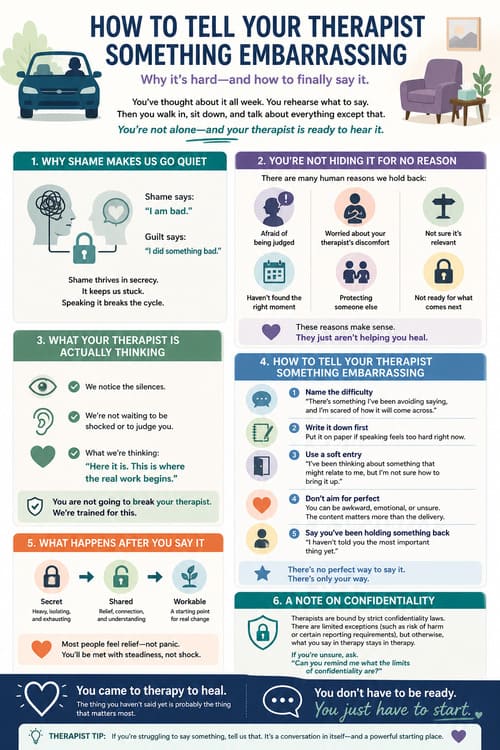
Shame is different from guilt. Guilt says: I did something bad. Shame says: I am bad. Guilt can motivate repair. Shame motivates hiding. And when we hide in therapy—the one place designed specifically for not hiding—we stay stuck.
The things we are most ashamed of are often the things most driving our pain: the affair, the addiction, the intrusive thought, the memory we’ve never spoken out loud, the part of the story we’ve edited out.
Therapists know this. We’re watching for it.
You’re Not Hiding It for No Reason
Before anything else, it’s important to say this: not saying something doesn’t mean you’re doing therapy wrong. It usually means you’re doing something very human.
There are many reasons people struggle with what to tell your therapist, especially when it involves shame.
You might be afraid of being judged. You’ve worked hard to present yourself as functional, self-aware, and composed. Saying the thing might disrupt that image, and you can’t take it back once it’s said.
You might be worried about your therapist’s reaction. Not necessarily judgment—but discomfort. What if it’s too much? What if they don’t know what to do with it?
You might think it’s not relevant. You came in for anxiety, work stress, or relationship issues. The other thing feels separate—but often, it’s the piece that connects everything.
You might be waiting for the right moment. Sessions move quickly. The topic shifts. You tell yourself you’ll bring it up next time.
You might be protecting someone else. Saying it out loud could feel like a betrayal.
Or you might not feel ready to deal with what happens after you say it. Because once it’s out there, it might require change.
All of this has logic. It just isn’t helping you move forward anymore.
What Your Therapist Is Actually Thinking
Here’s the part most people never hear: your therapist is not waiting to be shocked or to judge you.
We are noticing what isn’t being said.
The hesitation. The shift in topic. The story that stops just short of something important.
We’ve heard things—many things. Affairs, addictions, intrusive thoughts, trauma, experiences people have never shared with anyone else.
And the response is not judgment. It’s recognition:
“Here it is. This is where the real work begins.“
Nothing you say is going to make a competent therapist recoil. You are not going to overwhelm us. You are not going to break us.
The Shame You’re Carrying Is Keeping You Stuck
This pattern shows up constantly.
Unspoken shame often sits underneath:
- depression that doesn’t fully lift
- anxiety that feels vague but persistent
- relationships that feel blocked
- progress that stalls
Shame thrives in secrecy. It weakens when it’s spoken.
When something remains hidden, your mind treats it as evidence:
“If I can’t even say this in therapy, it must be as bad as I think.”
Saying it out loud interrupts that loop.
The disclosure itself is part of the work. Not because it solves everything—but because it brings the problem into the open, where it can actually be understood.
How to Tell Your Therapist Something Embarrassing
If you’re unsure how to tell your therapist something embarrassing, these approaches can help:
Start by naming the difficulty
You don’t have to lead with the content. Try:
“There’s something I’ve been avoiding saying, and I’m scared of how it will come across.”
That alone opens the door.
Write it down first
If speaking feels overwhelming, write it. Even fragments help. You can read it, hand it over, or use it as a starting point.
Use distance before directness
If saying it outright feels impossible:
“I’ve been thinking about something I relate to, but I’m not sure how to bring it up.”
That buffer can make the first step easier.
Don’t worry about saying it perfectly
You don’t need the right words. You can be awkward, emotional, or unsure. The content matters more than the delivery.
Say that you’ve been holding something back
Sometimes the most direct approach works best:
“I haven’t told you the most important thing yet.”
That’s enough. Your therapist will take it from there.
What Happens After You Say It
Most people expect panic. What they often feel instead is relief.
Not because the issue disappears—but because it’s no longer something you’re carrying alone.
A good therapist won’t react the way you fear. They’ll stay steady. Curious. Present.
You won’t become a different person in their eyes.
A Note on Confidentiality
A common concern is whether saying something could lead to consequences.
Therapists are bound by strict confidentiality laws. There are limited exceptions—typically involving immediate risk of harm or certain reporting requirements—but otherwise, what you say in therapy stays there.
If you’re unsure, ask:
“Can you remind me what the limits of confidentiality are?”
That’s a completely appropriate question.
Final Thoughts:
You came to therapy to heal. That’s worth remembering.
You came because something wasn’t working. Because carrying it alone wasn’t enough.
The thing you haven’t said yet is probably not random. It’s probably central.
Your therapist isn’t waiting for the polished version of you. They’re waiting for the honest one.
You don’t have to feel ready.
You just have to start.
Sources:
- Brown, B. (2015). Daring Greatly. Avery Publishing.
- Rubin, S. (2021). Shame and Countertransference. HealingShame.com