

Table of Contents
Affiliate link notice: As an affiliate of BetterHelp and other third-party vendors, we may receive compensation if you make a purchase using the links provided on this page. For more information, visit our disclosure page.
Last Updated on March 9, 2026 by Randy Withers
Cognitive distortions do not care about your screen time goals.
They do not care about the grayscale filter you turned on last Tuesday, the app you downloaded to block other apps, or the solemn promise you made yourself on Sunday night to stop scrolling before bed. Cognitive distortions are systematic errors in thinking, first identified by psychiatrist Aaron Beck in the 1960s and later expanded by David Burns in Feeling Good. They show up in depression. They show up in anxiety, addiction, and disordered eating. And they show up every single time you pick up your phone for no reason—which, if you are being straight with yourself, probably happened at least twice in the last hour.
What makes them dangerous is that they feel rational. As Harvard Health’s Peter Grinspoon puts it, they are “internal mental filters or biases that increase our misery, fuel our anxiety,” and they often operate below conscious decision-making. You do not choose to think this way. Your brain defaults to it.
That matters more than most people realize when it comes to smartphones. Many people casually describe their relationship with their devices as phone addiction, but clinicians and researchers often use more precise terms like problematic smartphone use or compulsive phone use. Whatever you call it, the pattern is familiar: you check your phone without thinking, scroll longer than you meant to, and reach for it automatically whenever your brain wants a quick distraction.
Technology design certainly plays a role, but distorted thinking patterns quietly reinforce the behavior. They justify the checking. They normalize the scrolling. They convince you that one more glance at your phone makes perfect sense—even when you already know it probably doesn’t.
Below are six cognitive distortions that frequently show up behind compulsive phone use.
What Are Cognitive Distortions?
Cognitive distortions are predictable errors in thinking. They are the brain’s way of simplifying complicated emotional information, but the shortcuts often come at a cost.
Psychiatrist Aaron Beck first identified these patterns while studying depression in the 1960s. He noticed that people struggling psychologically often interpreted ordinary situations through distorted mental filters. Instead of evaluating events objectively, their thoughts bent automatically toward extreme, exaggerated, or self-defeating conclusions. David Burns later expanded this work and helped popularize the concept in Feeling Good.
The important thing to understand is that these thinking patterns are not random. They follow recognizable rules.
Someone prone to catastrophizing assumes the worst possible outcome. Someone engaging in all-or-nothing thinking sees situations in rigid extremes. Emotional reasoning convinces us that if something feels true, it must be true. These distortions operate quickly and usually outside conscious awareness, which is why they feel so convincing in the moment.
Where Cognitive Distortions Show Up in Your Phone Habits
Once you start looking for cognitive distortions, they appear everywhere in modern technology use. Smartphones create the perfect environment for them: constant notifications, infinite content, and endless opportunities to check whether something new has happened.
Most people assume their phone habits are driven by boredom or habit alone. In reality, the urge to check your phone is often fueled by specific distorted thoughts that make the behavior feel logical in the moment.
Below are six cognitive distortions that frequently show up behind compulsive phone use.
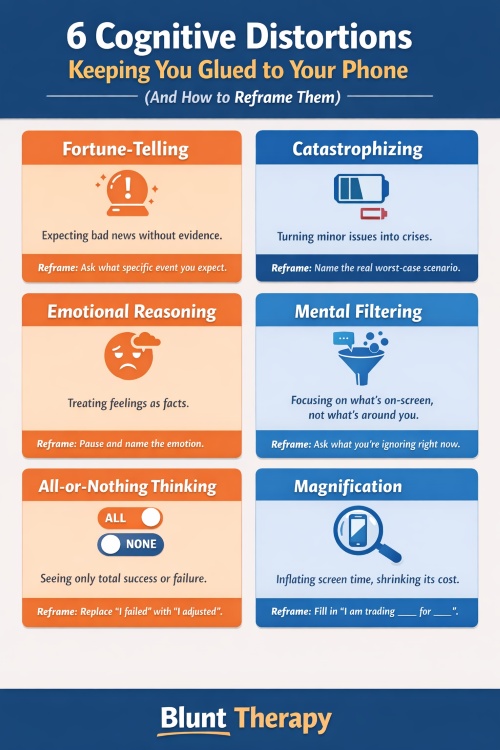
1. Fortune-Telling
A graduate student once described her morning routine to me. Alarm goes off. Hand reaches for the nightstand. Thumb unlocks the screen before her eyes have adjusted. She checks email, texts, two social platforms, and a news app. Every single morning. She said it was to make sure nothing bad had happened overnight.
Nothing bad had happened overnight. Not once in the fourteen months she had been doing this.
Fortune-telling is the distortion of predicting negative outcomes without evidence. Your brain manufactures a low-level dread—a quiet insistence that something urgent must have arrived while you slept—and the only way to quiet it is to check. Research on nomophobia have documented this pattern clinically, with one study finding that 53% of UK mobile users experienced genuine anxiety symptoms (trembling, perspiration, rapid heart rate) when separated from their devices. The phone does not need to deliver an actual emergency. The possibility of one is enough to keep you reaching for it.
The reframe: Ask yourself what specific event you expect to find. If you cannot name one, you are fortune-telling.
2. Catastrophizing
A man in his forties once told his therapist he had left a restaurant mid-meal because his phone dropped to 8% battery and he needed to find a charger. He was not expecting a call. No pending emergency existed. But the thought of his phone dying felt, in his own words, “like being stranded.”
He was sitting in a restaurant with his wife. He was not stranded.
Catastrophizing takes a manageable inconvenience and inflates it into a disaster. A low battery becomes isolation. A missed notification becomes a ruined relationship. The distortion scales consequences far beyond what the evidence supports. Research on nomophobia have documented this pattern clinically, and the anxiety produced by phone separation mirrors physiological markers seen in panic disorders. Your body responds to a dead phone the way it would respond to a genuine threat, which is a staggering thing to type, but the data backs it up.
The reframe: Name the actual worst-case scenario out loud. “My phone dies and I cannot check Instagram for two hours.” Hear how that sounds.
3. Emotional Reasoning
She picked up her phone because she was bored. That is what she said. But she had been reading a novel she enjoyed, sitting on her porch on a Saturday afternoon, before the urge arrived. She was not bored. She felt a flicker of restlessness, and her brain labeled it boredom and handed her the phone as the fix.
Emotional reasoning is the distortion of treating feelings as facts. You feel anxious, so something must be wrong. You feel restless, so you must need stimulation. Gangemi, Dahò, and Mancini found in a 2021 review, that anxious individuals consistently inferred danger from their own anxious feelings rather than from any external evidence. The feeling became its own proof. A meta-analysis on emotion regulation and problematic smartphone use, confirmed the connection: people with greater difficulty regulating emotions showed significantly higher rates of compulsive phone use, with the strongest effects in younger populations.
The reframe: When you reach for your phone, pause and name the emotion driving it—boredom, anxiety, loneliness. Then ask whether the phone will actually resolve that emotion or simply postpone it.
4. Mental Filtering
Two friends are at dinner. One of them has her phone face-up on the table, checking Instagram between bites of pad thai. She is not disengaged from the conversation; she is splitting her attention because somewhere in the back of her mind she has decided that what is happening on her screen might matter more than what is happening at her table.
It does not. But the filter will not let her see that.
Mental filtering is the distortion of selectively attending to one category of information while ignoring another. In the context of phone addiction, this often manifests as FOMO. FOMO is not an emotion. It is a cognitive distortion wearing its clothes. Li et al. found in a 2020 study of 1,164 university students, that negative emotions predicted compulsive phone use through two pathways: first through fear of missing out, then through the smartphone dependency that FOMO generates. The connection ran in one direction only. Positive emotions bypassed the loop entirely.
The filter is invisible. Research comparing self-reported and objectively measured phone use, found that people who were aware of their own overuse still underestimated their actual screen time by roughly 40%. You cannot notice how much you are filtering because the filtering itself runs on autopilot.
The reframe: Ask yourself what you are ignoring while you check your phone. The conversation, the person in front of you, the quiet moment you were just having. Mental filtering works by shrinking what matters in front of you and enlarging what might be happening somewhere else.
5. All-or-Nothing Thinking
He deleted every social app on a Sunday. By Wednesday, every single one of them was back on his phone. He told himself the experiment had failed, so what was the point in trying some modified version? Total abstinence or nothing.
All-or-nothing thinking is the distortion that categorizes outcomes in binary terms: complete success or complete failure. You set an extreme standard. You fall short. And instead of adjusting the standard, you quit. The all-or-nothing frame is seductive because it feels decisive, but decisiveness without nuance is just rigidity wearing a motivational T-shirt.
A 2025 randomized controlled trial in BMC Medicine found that participants who reduced their screen time to two hours or less per day showed significant improvements in depressive symptoms, stress levels, and sleep quality within three weeks. A separate 2025 study in PNAS Nexus found that blocking only mobile internet—while keeping calls and texts—led to measurable gains in sustained attention and well-being for 91% of participants.
You do not need to throw your phone into a river. Partial reduction works.
The reframe: Replace “I failed” with “I adjusted.” Reduction is not the same as defeat.
6. Magnification
The scroll itself is the tell. You inflate the potential value of the next post, the next notification, the next refresh, while shrinking the cost of the time you are burning through. Twenty minutes becomes “just a few minutes.” An hour becomes “I wasn’t doing anything important anyway.”
Magnification inflates the significance of one thing while minimizing another. With phone use, you magnify the reward of the next piece of content and minimize the cost of your attention.
A 2022 study in PLoS One found that even hearing a smartphone notification sound—without checking the phone—was enough to slow response times and recruit additional cognitive resources. The distraction is not the content itself. It is the anticipation. Your brain assigns enormous value to whatever might be waiting on that screen and almost no value to the focus you sacrifice to go check.
The reframe: Before you pick up your phone, finish this sentence: “I am trading _____ for the chance to see _____.” Fill in both blanks. No hedging.
Final Thoughts
Compulsive phone use rarely begins as a technology problem. It begins as a thinking problem.
Your phone does not reach for itself. Your brain supplies the justification. A quiet prediction that something important might be waiting. A feeling that boredom must be solved immediately. A belief that missing one notification could somehow matter more than the moment you are currently living in.
Cognitive distortions thrive in environments that reward quick reactions and constant checking, which makes smartphones the perfect habitat for them. Every notification promises something potentially important. Every refresh offers the possibility of something new. The distortions fill in the rest of the story and make the habit feel reasonable.
But once you recognize the thinking patterns behind compulsive phone use, the behavior becomes easier to interrupt. You start to notice the fortune-telling when you feel the urge to check your phone first thing in the morning. You recognize the catastrophizing when a low battery suddenly feels like a crisis. You catch the emotional reasoning when restlessness convinces you that scrolling will fix it.
That moment of recognition matters.
You do not need perfect discipline or extreme digital detoxes to change your relationship with your phone. What you need is awareness of the distorted thinking patterns that keep pulling your attention back to the screen.
The distortions do not disappear overnight. But once you see them clearly, they lose a surprising amount of their power.
And sometimes that is enough to put the phone down.
A Quick Reality Check
Before you reach for your phone again today, pause and ask yourself three questions:
1. What distortion might be operating right now?
Am I fortune-telling about a message that probably does not exist? Catastrophizing a missed notification? Treating a feeling of restlessness as a command to scroll?
2. What am I actually feeling?
Boredom, anxiety, loneliness, fatigue. Phones often become a reflexive response to emotions that have nothing to do with technology.
3. What am I trading away to check this right now?
Focus. Conversation. Quiet. Sleep. Attention.
None of this means you have to eliminate your phone from your life. But recognizing the thinking patterns behind compulsive phone use gives you something most people never develop: the ability to pause before the habit takes over.
And that pause is where real control begins.
References
1. Bhattacharya, S., Bashar, M. A., Srivastava, A., & Singh, A. (2019). NOMOPHOBIA: NO MObile PHone PhoBIA. Journal of Family Medicine and Primary Care, 8(4), 1297-1300. https://pmc.ncbi.nlm.nih.gov/articles/PMC6510111/
2. Lee, H., Ahn, H., Nguyen, T. G., Choi, S. W., & Kim, D. J. (2017). Comparing the Self-Report and Measured Smartphone Usage of College Students: A Pilot Study. Psychiatry Investigation, 14(2), 198-204. https://pmc.ncbi.nlm.nih.gov/articles/PMC5355019/
3. Gangemi, A., Dahò, M., & Mancini, F. (2021). Emotional Reasoning and Psychopathology. Brain Sciences, 11(4), 471. https://pmc.ncbi.nlm.nih.gov/articles/PMC8068126/
4. Li, L., Griffiths, M. D., Mei, S., & Niu, Z. (2020). Fear of Missing Out and Smartphone Addiction Mediates the Relationship Between Positive and Negative Affect and Sleep Quality Among Chinese University Students. Frontiers in Psychiatry, 11, 877. https://www.frontiersin.org/journals/psychiatry/articles/10.3389/fpsyt.2020.00877/full
5. Castelo, N., Kushlev, K., Ward, A. F., Esterman, M., & Reiner, P. B. (2025). Blocking mobile internet on smartphones improves sustained attention, mental health, and subjective well-being. PNAS Nexus, 4(2), pgaf017. https://pubmed.ncbi.nlm.nih.gov/39967678/
6. Upshaw, J. D., Stevens, C. E., Ganis, G., & Zabelina, D. L. (2022). The hidden cost of a smartphone: The effects of smartphone notifications on cognitive control from a behavioral and electrophysiological perspective. PLoS One, 17(11), e0277220. https://pmc.ncbi.nlm.nih.gov/articles/PMC9671478/
7. Shahidin, S. H., Midin, M., Sidi, H., et al. (2022). The Relationship between Emotion Regulation and Problematic Smartphone Use: A Systematic Review and Meta-Analysis. International Journal of Environmental Research and Public Health, 19(23), 16176. https://pmc.ncbi.nlm.nih.gov/articles/PMC9740505/
8. Grinspoon, P. (2022). How to recognize and tame your cognitive distortions. Harvard Health Publishing. https://www.health.harvard.edu/blog/how-to-recognize-and-tame-your-cognitive-distortions-202205042738
9. Pieh, C., Humer, E., Hoenigl, A., Schwab, J., Mayerhofer, D., Dale, R., & Haider, K. (2025). Smartphone screen time reduction improves mental health: a randomized controlled trial. BMC Medicine, 23, 112. https://pubmed.ncbi.nlm.nih.gov/39985031/