Table of Contents
Affiliate link notice: As an affiliate of BetterHelp and other third-party vendors, we may receive compensation if you make a purchase using the links provided on this page. For more information, visit our disclosure page.
Last Updated on June 3, 2026 by Randy Withers
Most people think they’re pretty familiar with anxiety symptoms.
They picture worry. They picture nervousness before a big presentation, a job interview, or an important conversation. They picture a mind that won’t slow down at bedtime.
Sometimes anxiety looks exactly like that.
Sometimes it looks like the headache you’ve had for months. Sometimes it’s the knot in your stomach that shows up every Sunday afternoon. Sometimes it’s the exhaustion that follows you through the day no matter how much sleep you get. Sometimes it’s the constant need to double-check things, seek reassurance, or prepare for every possible problem before it happens.
Many people live with anxiety for years without realizing it. They assume they’re stressed, overworked, perfectionistic, sensitive, or simply bad at relaxing. Others become convinced that something is physically wrong because the symptoms feel so real. They schedule doctor’s appointments, change their diets, buy supplements, or search the internet for answers, only to discover that nothing seems to explain why they feel the way they do.
The problem is that anxiety rarely arrives with a name tag.
Instead, it tends to blend into everyday life. A racing mind becomes “just the way I am.” Poor sleep becomes normal. Muscle tension becomes background noise. Avoidance starts to feel practical. Before long, behaviors and symptoms that deserve attention begin to feel routine.
Why Anxiety Symptoms Are Easy to Miss
One reason anxiety symptoms often go unrecognized is that many of them don’t seem unusual at first. Most people worry from time to time. Most people lose sleep occasionally, feel stressed at work, or find themselves preoccupied with a problem they can’t solve.
Anxiety also tends to develop gradually. Few people wake up one morning and suddenly find themselves overwhelmed by anxiety. More often, the changes happen slowly. A little extra worry becomes a habit. Sleep becomes less restorative. Small decisions require more thought than they once did. Activities that used to feel easy begin to feel draining.
Another challenge is that anxiety doesn’t affect everyone the same way. One person may experience physical symptoms such as headaches, digestive issues, or muscle tension. Another may notice racing thoughts, irritability, or difficulty concentrating. Someone else may primarily struggle with avoidance, procrastination, or a constant need for reassurance.
With that in mind, here are seven anxiety symptoms that frequently get mistaken for something else.
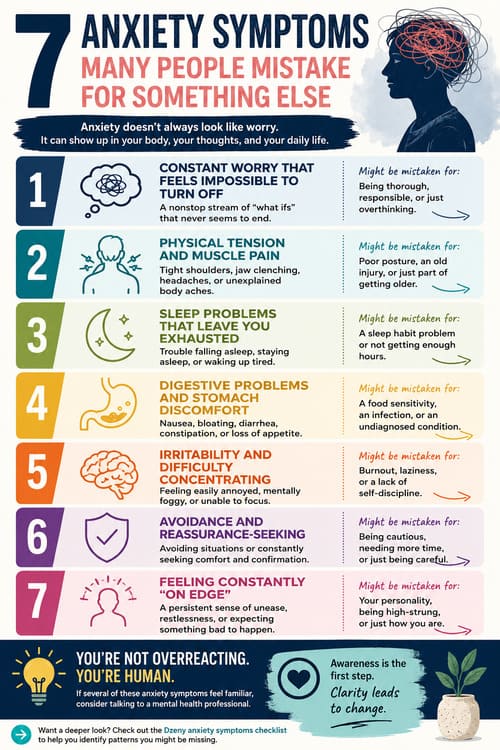
7 Anxiety Symptoms Many People Mistake for Something Else
Anxiety doesn’t always announce itself with panic attacks or obvious fear. In many cases, it shows up in quieter ways that are easy to rationalize, dismiss, or attribute to something else. Some anxiety symptoms affect the body. Others influence thought patterns, decision-making, and behavior.
The symptoms below are not meant to diagnose an anxiety disorder. Instead, they offer a framework for understanding how anxiety often presents in real life. You may recognize one or two of these signs, or you may find that several of them describe your experience.
1. Constant Worry That Feels Impossible to Turn Off
Worry serves a purpose. It helps people anticipate problems, prepare for challenges, and think through important decisions. Most of the time, however, worry reaches a natural stopping point. A decision gets made, a problem gets solved, or circumstances change.
Anxiety often works differently.
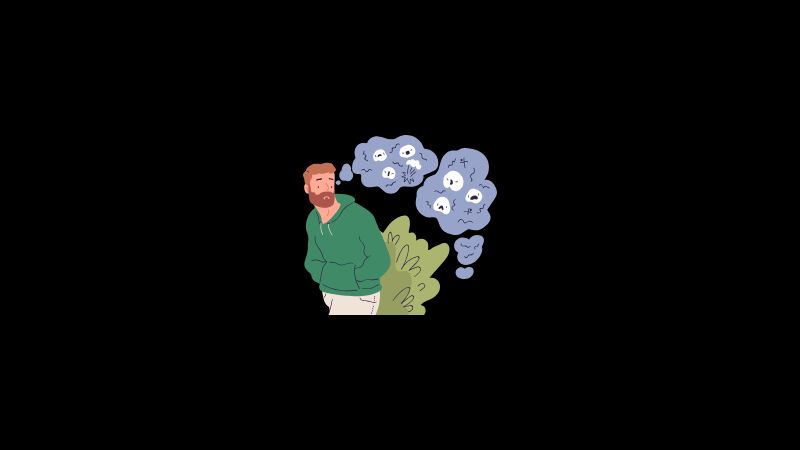
Instead of helping you arrive at a solution, anxiety keeps the conversation going. One concern leads to another. Questions generate more questions. Even after a problem has been addressed, the mind quickly finds a new possibility to examine or a new outcome to fear.
People frequently describe this experience as feeling trapped in their own thoughts. They replay conversations, second-guess decisions, imagine worst-case scenarios, or spend hours trying to predict situations that may never happen. The goal is usually certainty, but certainty rarely arrives. The more a person searches for reassurance, the more uncertainty seems to grow.
Over time, this constant mental activity becomes exhausting. Concentration suffers. Decision-making becomes harder. Small choices begin to feel disproportionately important because every option seems to carry hidden consequences.
One reason this anxiety symptom often goes unnoticed is that chronic worriers frequently view it as part of their personality. They tell themselves they’re simply thorough, responsible, or detail-oriented. While those qualities can certainly be strengths, there is a difference between thoughtful planning and a mind that refuses to disengage from potential problems.
2. Physical Tension and Muscle Pain
Most people think of anxiety as a mental experience, but the body often gets involved long before a person consciously recognizes what’s happening.
When the brain perceives a threat, it prepares the body for action. Muscles tighten, breathing changes, and the nervous system shifts into a heightened state of alertness. In the short term, this response can be useful. The problem arises when the body remains in that state long after the situation that triggered it has passed.
Many people with anxiety carry tension in their shoulders, neck, jaw, back, or hips without realizing it. They may grind their teeth at night, clench their jaw throughout the day, or constantly hold their shoulders in a raised position. Others experience frequent headaches, soreness, or a general feeling of stiffness that seems to have no obvious cause.
Because these symptoms feel physical, people often assume the explanation must be physical as well. They blame poor posture, age, exercise habits, or an old injury. While those factors can certainly contribute, anxiety frequently plays a larger role than people realize.
A person can become so accustomed to carrying tension that it no longer feels unusual. What once would have been uncomfortable begins to feel normal. Unfortunately, the body still pays the price.
3. Sleep Problems That Leave You Exhausted
Nearly everyone experiences a bad night of sleep from time to time. Anxiety-related sleep problems are different because they tend to become recurring patterns rather than occasional disruptions.
Some people struggle to fall asleep because their minds won’t slow down. Others fall asleep easily but wake up repeatedly throughout the night. Still others sleep for eight or nine hours and wake feeling exhausted.
The relationship between anxiety and sleep can quickly become a vicious cycle. Anxiety interferes with sleep, and poor sleep makes anxiety harder to manage. As fatigue builds, concentration suffers, patience wears thin, and even small stressors begin to feel overwhelming.
Many people assume their sleep difficulties are the primary problem. They focus on improving sleep hygiene, changing mattresses, taking supplements, or adjusting bedtime routines. While these strategies can help, they often fail to produce lasting improvement when anxiety remains unaddressed.
A useful question to ask is not simply, “How much am I sleeping?” but rather, “What is happening in my mind before I go to sleep?” The answer often reveals that anxiety has been present much longer than the sleep problem itself.
4. Digestive Problems and Stomach Discomfort
Few people associate stomach problems with anxiety, yet the connection between the digestive system and the nervous system is remarkably strong.
Think about the last time you felt extremely nervous. Chances are you noticed it in your stomach. Maybe your appetite disappeared. Maybe you felt nauseated. Maybe you experienced what people commonly call “butterflies.”
Anxiety operates through the same pathways, but on a larger and more persistent scale.
People with chronic anxiety frequently report stomach pain, bloating, nausea, diarrhea, constipation, or changes in appetite. Some find that symptoms worsen before social events, important meetings, travel, or other situations that trigger worry.
What makes these symptoms particularly confusing is that medical testing often reveals little or nothing. The symptoms are real, but the source may be a nervous system that remains stuck in a state of heightened alertness.
For many individuals, digestive issues become one of the earliest physical anxiety symptoms to appear.
5. Irritability and Difficulty Concentrating
When most people think about anxiety, irritability rarely comes to mind. Yet for many individuals, irritability is one of the most noticeable signs that something is wrong.
Anxiety places a constant demand on mental resources. The brain spends time scanning for problems, evaluating risks, and preparing for outcomes that may never occur. That leaves less energy available for focus, patience, and problem-solving.
As a result, small frustrations can begin to feel disproportionately aggravating. Minor inconveniences trigger outsized reactions. A simple interruption becomes difficult to tolerate. Tasks that once required little effort suddenly feel mentally exhausting.
Concentration often suffers as well. People may find themselves rereading the same paragraph multiple times, forgetting details, losing track of conversations, or struggling to stay engaged with work.
Many people interpret these difficulties as laziness, burnout, or a lack of discipline when anxiety may be the real culprit.
6. Avoidance and Reassurance-Seeking
One of anxiety’s primary goals is protection.
The problem is that anxiety often tries to protect people from situations that aren’t actually dangerous.
When worry becomes intense, people naturally look for ways to reduce discomfort. Sometimes that means avoiding situations that trigger anxiety. Other times it means seeking reassurance from friends, family members, partners, or the internet.
Avoidance can look obvious, such as refusing to attend social events or declining opportunities that involve uncertainty. It can also appear in subtler ways. A person may procrastinate on important tasks, delay difficult conversations, or continually postpone decisions because the discomfort feels overwhelming.
Reassurance-seeking follows a similar pattern. Someone may repeatedly ask loved ones whether everything is okay, double-check decisions, research symptoms online, or seek constant confirmation that they haven’t made a mistake.
These behaviors provide temporary relief. Unfortunately, the relief rarely lasts. The unanswered question soon returns, often stronger than before.
7. Feeling Constantly “On Edge”
Some anxiety symptoms are easy to identify. Others are much harder to describe.
Many people with anxiety report a persistent sense that something isn’t quite right, even when they can’t explain why. They feel restless, tense, uneasy, or perpetually braced for something bad to happen.
This experience often shows up as difficulty relaxing. Vacations feel stressful instead of restorative. Quiet moments feel uncomfortable. Downtime becomes an opportunity for worry rather than recovery.
Others describe feeling unusually sensitive to changes in their environment. They notice shifts in tone, facial expressions, or social dynamics that other people barely register. Their attention remains focused on what could go wrong rather than what is actually happening in the present moment.
Because the feeling is often subtle and familiar, many people assume it’s simply part of their personality. In reality, a constant sense of unease is one of the most common anxiety symptoms people overlook.
When Anxiety Symptoms Start Affecting Daily Life
An Experience with one or two symptoms from this list doesn’t necessarily mean you have an anxiety disorder. Everyone worries. Everyone loses sleep occasionally. Everyone experiences stressful periods.
The difference often comes down to frequency, intensity, and impact.
Anxiety becomes more concerning when symptoms begin to influence daily life in meaningful ways. Work becomes harder because concentration is difficult. Relationships suffer because reassurance-seeking, irritability, or worry take up more space than they used to. Activities that should feel enjoyable begin to feel exhausting.
Sometimes the impact is obvious. A person stops traveling, avoids social situations, or turns down opportunities because uncertainty feels overwhelming. Other times, the effect is much more subtle. Decisions take longer. Confidence erodes. Everyday tasks require more mental energy than they once did. Life slowly starts revolving around the avoidance of discomfort rather than the pursuit of meaningful goals.
This gradual shift is one reason anxiety can be difficult to recognize. What begins as caution becomes hesitation. What begins as preparation becomes overthinking. What begins as stress becomes a pattern that quietly shapes daily life.
A structured checklist can be a genuinely useful tool — not to self-diagnose, but to bring some clarity to what you’re going through. If you want a more thorough framework, this Dzeny anxiety symptoms checklist walks you through both the physical and psychological indicators in a way that helps you spot patterns you might have missed.
While no checklist can diagnose an anxiety disorder, it can help organize your observations, identify recurring themes, and determine whether it may be worth discussing your concerns with a qualified mental health professional.
Final Thoughts
Many people spend years treating the consequences of anxiety without recognizing anxiety itself.
They focus on poor sleep, digestive issues, headaches, irritability, fatigue, or difficulty concentrating. They assume they’re stressed, overworked, overly sensitive, or simply wired a certain way. Because anxiety can affect so many different areas of life, it often hides in plain sight.
That doesn’t mean every symptom on this list points to an anxiety disorder. Life is complicated, and physical or emotional symptoms can have many causes. What matters is the pattern. When worry becomes persistent, when tension feels constant, or when anxiety begins to shape decisions, relationships, and daily routines, it deserves attention.
The encouraging news is that anxiety is highly treatable. Many people experience significant improvement through therapy, lifestyle changes, stress-management strategies, medication, or a combination of approaches.
If several of these anxiety symptoms felt familiar, consider it an invitation to become more curious rather than more concerned. Anxiety thrives in confusion and uncertainty. Clarity often marks the beginning of change.